
How does a silo tanker load travel from Turkey to Bulgaria? The tanker is loaded at the plant in Turkey and crosses into Bulgaria at Kapıkule or Hamzabeyli in Edirne, or into Greece at İpsala. Industrial goods travel with an A.TR movement certificate, transit usually runs on a T1 declaration through NCTS, and the driver holds a Schengen visa. At delivery the tank is discharged by compressor into the receiver's silo.
We do not run a fixed schedule on this route. After receiving your request we check the route, road permits and documents and reply in writing. The same applies to loads coming into Turkey.
Border crossings: Kapıkule, Hamzabeyli, İpsala
The main road freight crossing into Bulgaria is Kapıkule in Edirne, opposite Kapitan Andreevo on the Bulgarian side. Hamzabeyli (Lesovo on the Bulgarian side) is used to take truck traffic away from Kapıkule. Greece is entered at İpsala. The crossing is chosen by the delivery point and by the queue at the gate.
Trucks bound for Romania transit Bulgaria and enter Romania over the Danube bridges, for example the Ruse-Giurgiu bridge. North Macedonia, Serbia and Hungary are also reached through Bulgaria.
Italy and Western Europe: Ro-Ro ferry to Trieste and Sète
Loads to Italy and Western Europe usually go by Ro-Ro ferry instead of overland: the truck, or the trailer alone, boards the ship at a Turkish port, lands at Trieste in Italy and continues by road to the delivery point. There are regular Ro-Ro sailings from Pendik, Mersin and Martaş (Tekirdağ) to Trieste, and from Yalova and İzmir to Sète in France. These lines are run by ferry operators; sailing day, space and rate are confirmed with the operator for each request.
ADR loads are accepted on these Ro-Ro lines, except explosives (class 1) and radioactive material (class 7); ADR units have an earlier cut-off time. From Trieste the load continues by road to plants in Austria, Germany and northern Italy, where the Schengen visa, road permits and the 40-tonne EU limit apply on that leg too.
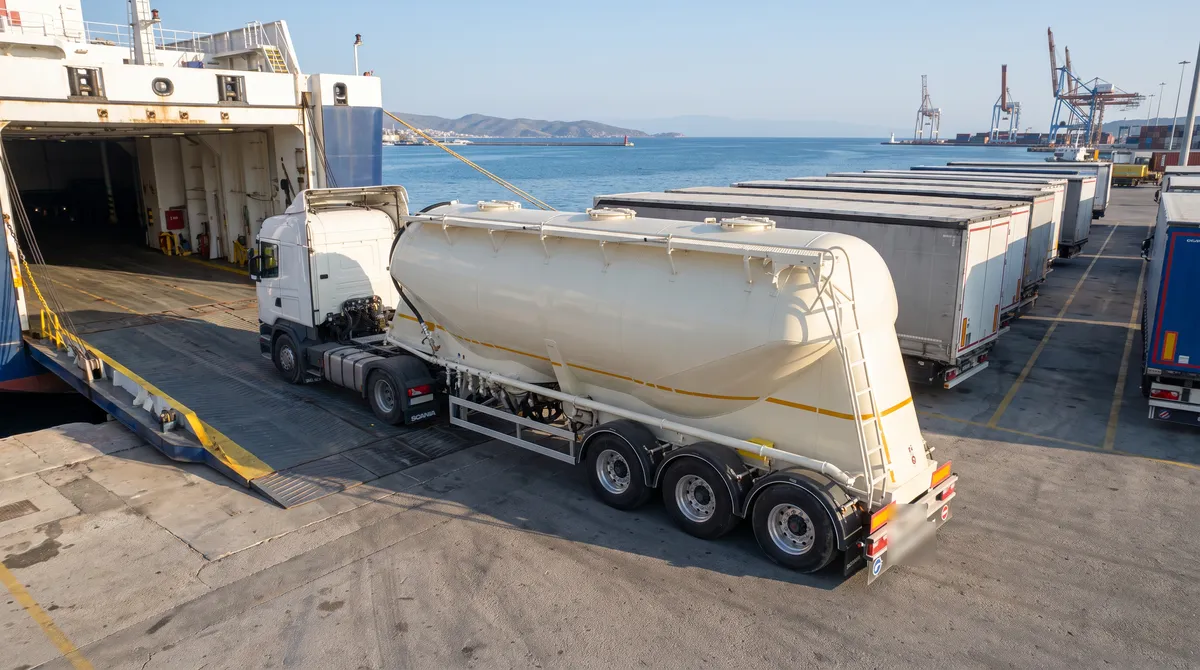
Turkey to Italy: industrial minerals and contact
Documents: A.TR, T1 transit and CMR
Turkey and the European Union have a customs union for industrial goods, so cement, calcite, mineral powders and plastic raw materials travel with an A.TR movement certificate. Turkey has been a party to the Common Transit Convention since 2012; the load can travel to the customs office of destination under a T1 transit declaration opened in NCTS.
On the carrier's side the truck carries a CMR consignment note, the C2 authorisation for international haulage and the driver's SRC 3 certificate. The export declaration and invoice are prepared by the shipper; having them ready before the truck arrives for loading shortens the wait at the border.
Driver visa, road permits and driving bans
Bulgaria and Romania joined the Schengen area in 2025, Greece much earlier, so every trip on this route needs a driver with a valid Schengen visa. Several European countries require bilateral or transit road permits for Turkish-registered trucks; permit quotas are limited and are part of the date planning.
Some European countries ban heavy goods vehicles on weekends and public holidays. The loading date is chosen with these days in mind, otherwise the truck waits on the road.
Payload: the 40-tonne limit in the EU
In the European Union the permitted gross weight of a five-axle tractor and semi-trailer in international traffic is 40 tonnes. On a standard trip the tank carries 26 tonnes and the vehicle stays within this limit. The load is weighed at the loading point and the weighbridge ticket travels with the documents. With light products such as polymer granules, the tank volume is the limit.
Loads from the Balkans and Europe into Turkey
A truck that comes back loaded costs less than one that returns empty. If you ship powders or granules from Bulgaria, Romania, Greece or Italy into Turkey, send us your request as an import load; we try to match outbound and return legs on the same trip. The import declaration in Turkey is prepared by the receiver's customs broker.